Understanding Transport Streams and IP Delivery Protocols
8 min
Overview
Modern broadcast and streaming workflows rely on MPEG Transport Streams (TS) for reliable delivery of video, audio, and metadata across diverse networks. This document explains:
- How video and audio are encoded into transport streams.
- How receivers extract and decode these streams.
- How IP delivery protocols (SRT, RIST, Zixi) ensure resilience and quality.
Here's a basic architectural diagram of the encoding - decoding flow:
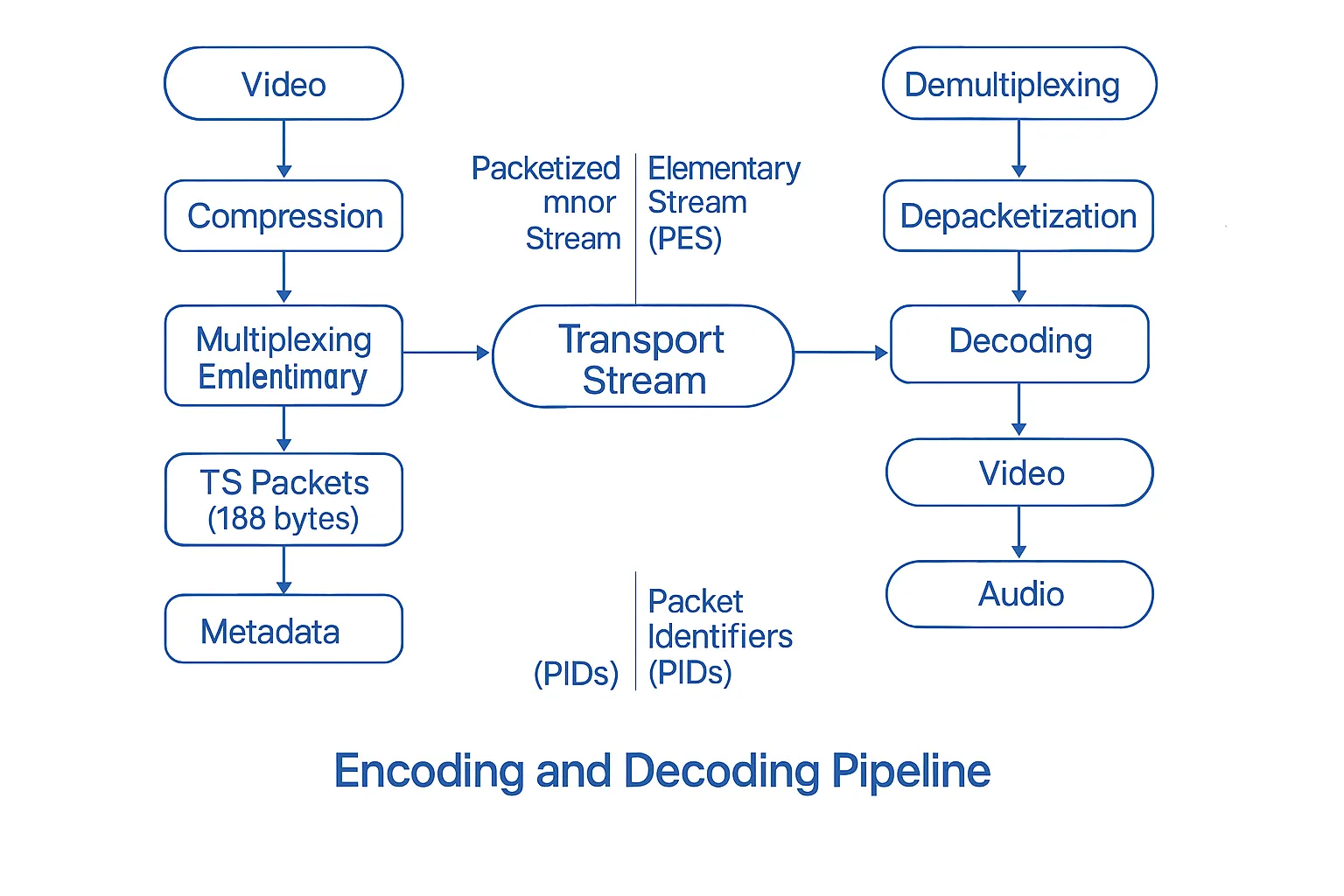
We will look at a more complete diagram after looking at some of the details of the process.
Encoding Pipeline
Step-by-Step Process
- Compression
- Video: H.264/AVC, HEVC (H.265), or MPEG-2.
- Audio: AAC, AC-3.
- Packetization
- Compressed streams become Elementary Streams (ES).
- ES wrapped into Packetized Elementary Streams (PES) with timing info ( PTS/DTS)
- Transport Stream Packetization
- PES split into 188-byte TS packets.
- Each packet includes:
- Sync byte (0x47) for alignment.
- PID (Packet Identifier) for stream identification.
- Optional adaptation field for timing (PCR [Program Clock Reference]).
- Multiplexing
- Video, audio, and metadata interleaved into one TS.
- PAT/PMT tables describe program structure.
- Metadata & Signaling
- SCTE-35 markers for ad insertion.
- Timing references (PTS/DTS, PCR) for synchronization.
Decoding Pipeline
- Demultiplexing
- Receiver uses PAT/PMT to identify PIDs.
- Depacketization
- TS packets → PES → ES.
- Decoding
- Video/audio are decoded using original codecs.
- Rendering
- Frames and audio are synchronized for playback.
IP Delivery Protocols
Why IP Delivery?
Traditional satellite/cable links are being augmented or replaced by IP-based transport for flexibility and cost efficiency. However, IP introduces packet loss, jitter, and latency challenges.
Protocols
- Zixi Protocol
- ARQ (Automatic Repeat reQuest) for packet recovery.
- FEC (Forward Error Correction) for proactive error handling.
- Bonding across multiple paths for resilience.
- AES-256 encryption and DTLS security.
- Integrated orchestration via ZEN Master.
- SRT (Secure Reliable Transport)
- ARQ-based recovery.
- AES encryption.
- Designed for low-latency contribution feeds.
- RIST (Reliable Internet Stream Transport)
- Standards-based.
- ARQ with optional FEC.
- Ideal for broadcast-grade reliability.
Error Correction Layers
- ARQ: Retransmits lost packets based on NACKs.
- FEC (Forward Error Correction): Adds redundant data for recovery without retransmission.
- Bonding: Distributes traffic across multiple links for hitless failover.
- Jitter Buffers: Smooth out packet arrival variations.
Timing & Signaling
- PTS/DTS: Presentation and decoding timestamps.
- PCR: Program Clock Reference for sync.
- SCTE-35: Ad signaling for dynamic ad insertion.
End-to-End Architecture
Source → Contribution → Core → Distribution → Affiliate
- Transport Stream encapsulated in IP packets.
- Delivered via SRT, RIST, or Zixi with error correction.
- Monitored via ZEN Master for SLA compliance.
Diagram
Here is a more complete diagram:
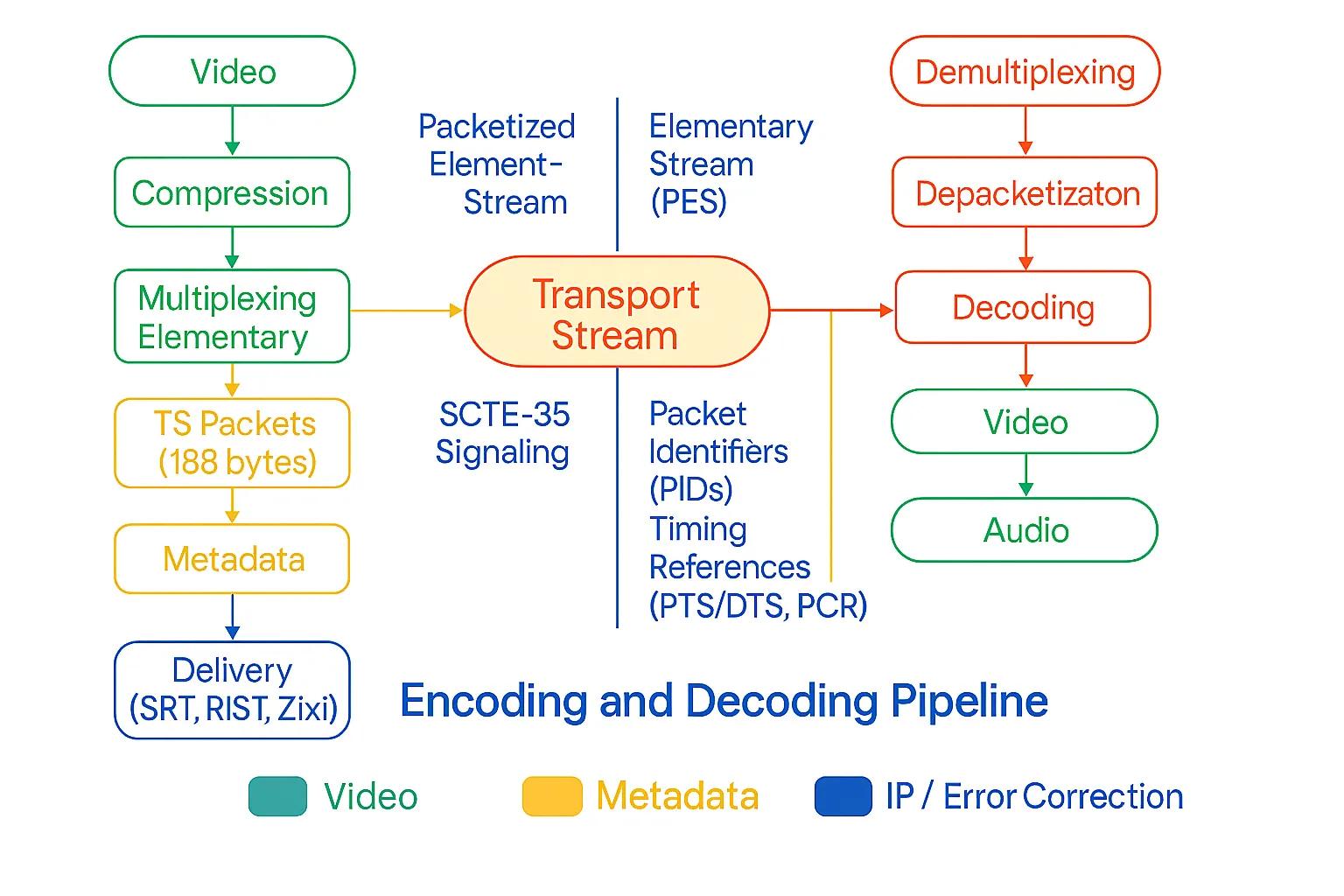
Key Benefits Zixi Provides
- Reliability: >99.999% uptime with bonding and error correction.
- Security: AES-256 encryption and DTLS.
- Flexibility: Multi-protocol support for diverse workflows.
- Visibility: Real-time telemetry and analytics via ZEN Master.