Adding a Source - Multiviewer
A Multiviewer source displays multiple video feeds in a grid-like view for monitoring purposes. It enables real-time monitoring and visualization of multiple video feeds in a single multi-viewer source, while displaying real-time statistics. ZEN Master offers one multi-viewer option:
- TAG Video Systems – ZEN Master supports TAG Video System’s Multi-Viewer solution (e.g., MCM-9000). Existing TAG deployments can be used without special integration. For more information, see - https://tagvs.com/
ZEN Master manages multi-viewers as objects in ZEN Master through the Multi-Viewers screen. Before creating a Multiviewer source, you will need to configure at least one Multiviewer in the Multi-Viewers section. For more detailed instructions, see the Multi-Viewers section.
The TAG Multiviewer needs to be preconfigured with the desired layout configurations, the Encoder profile, and other video settings.
The following steps describe how to add a Multiviewer Source in ZEN Master. An explanation of each configuration parameter is provided in the table below.
To add a Multiviewer Source:
In the main navigation, click Sources.
Click + Add. The Create New Source selection window is displayed.
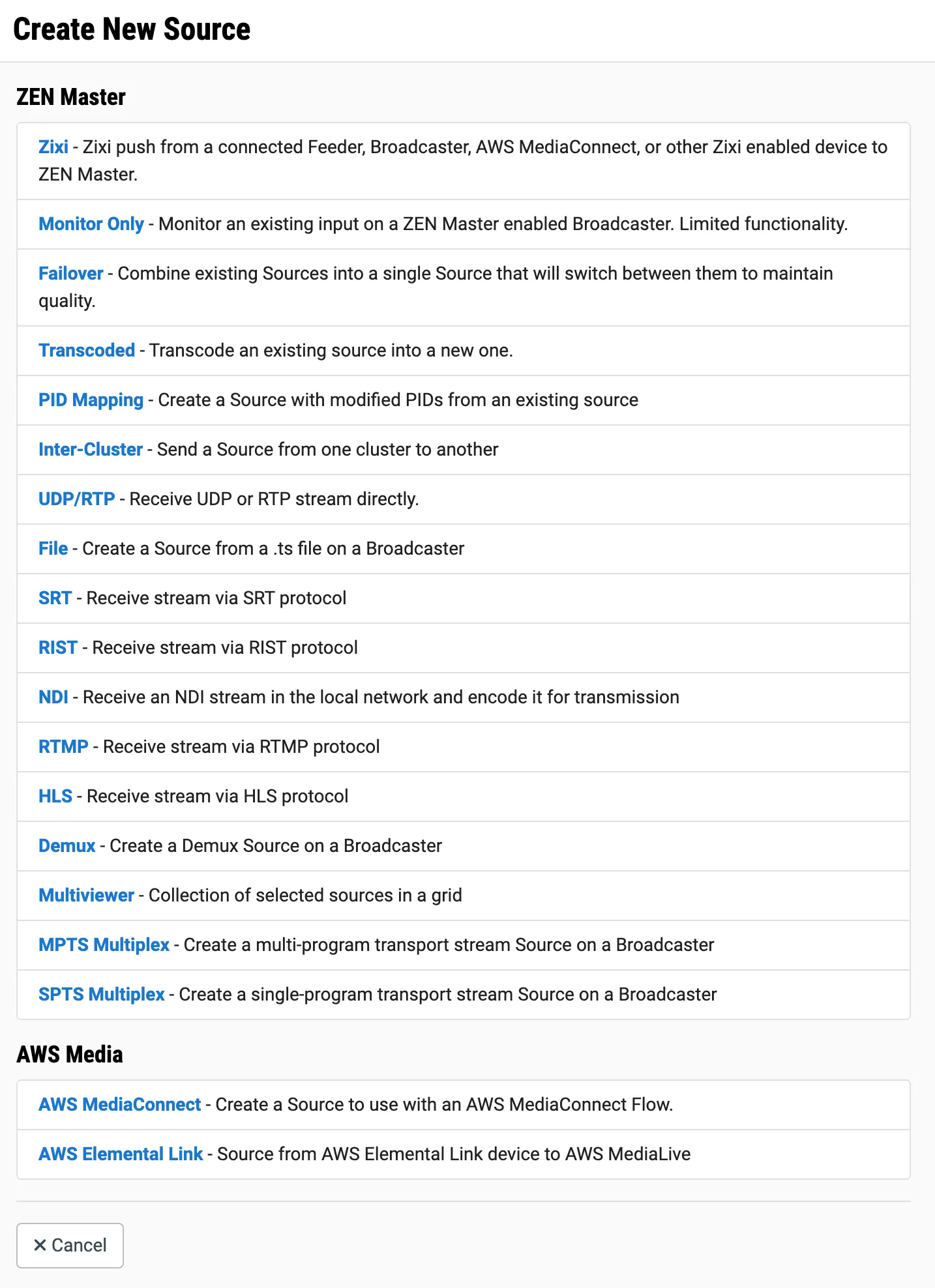
Click on Multiviewer. The Create New Multiviewer Source window opens.
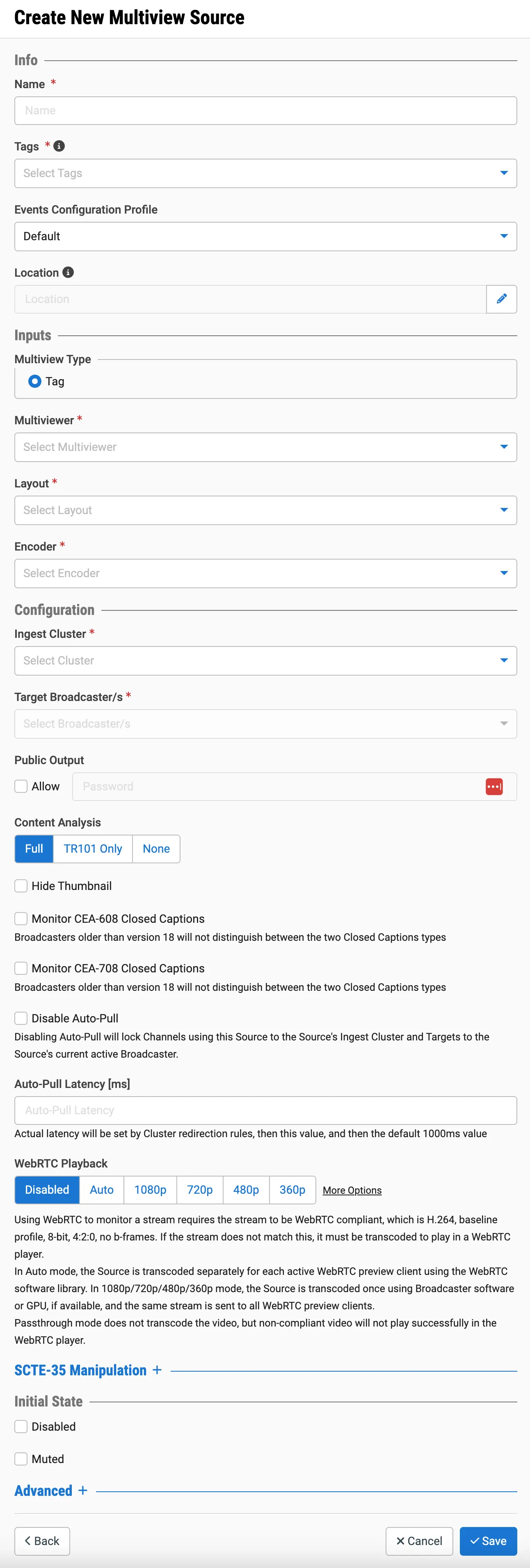
In the Info section, in the Name field, enter a unique name to identify this Source in the system.
In the Tags field, select one or more of the predefined Tags from the drop-down list. Tags are used for access control. By selecting a Tag, you are relating this Source to that Tag. Tags are associated with certain roles (through the Users & Roles screen), and roles, in turn, are associated with users and user groups. If you would like to create a new Tag, see Creating a Tag.
In the Events Configuration Profile field, select from the dropdown list the profile that you would like to apply to this Source. By default, the Default profile is applied.
Events Profiles consist of a series of rules that determine precisely how various types of Events are logged and what results they trigger.
The Source's location is used to represent it in the proper position in the Map display (see Maps). By default, the location is determined automatically based on the Source's IP. If you would like to manually set the location of the Source (Optional), use the following procedure:
- Click on the Edit icon next to the Location field. A search box is shown below the Location field.
- Enter identifying info for the location (e.g., street address, zip code, coordinates). Search results are displayed below the search box as you type.
- Click on the desired location. The selected location populates the Location field.
Under Inputs, under the Multiview Type, the following is the only multiviewer supported at this time:
- Tag – to use a TAG Video System’s Multi-Viewer solution (e.g., MCM-9000).
In the Multiviewer field, select the relevant Multiviewer from the drop-down menu. This list is populated by the objects that were configured in the @Multi-Viewers screen.
For TAG option, in the Layout field, select the desired layout from the list of preconfigured layouts. These layouts are configured in the TAG system itself. After selecting the desired layout, an empty grid is displayed with empty rectangles to assign the desired sources from the list of sources.
In the Encoder section, select the relevant Encoder profile. Encoders are configured in the TAG system itself.
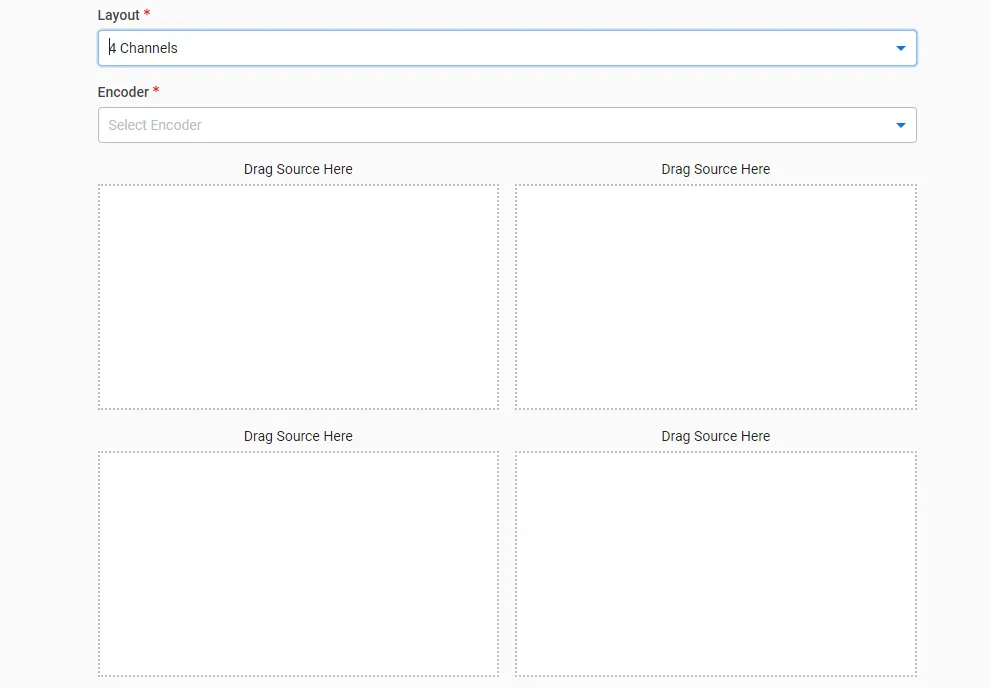
In the Sources section, do one of the following:
- Click the + button to add the source to the first (top left rectangle) and repeat the process to add sources to the designated grid spots (left to right, top to bottom).
- Drag the source to the relevant grid slot.
In the Configuration section, in the Ingest Cluster field, select from the drop-down list one of the available Ingest Clusters as the destination for the Source.
In the Target Broadcaster/s field, select your Broadcaster preference. Either select a specific Broadcaster to be used OR specify your preference for using primary vs. backup Broadcasters, options are: Prefer Primary Broadcasters, Primary Broadcasters only, Backup Broadcasters only, or Prefer Backup Broadcasters.
For managed Clusters, it is not recommended to select a specific Broadcaster, as the Broadcaster’s availability may not remain stable.
In the Public Output field, to allow access to the stream directly through a supported player, select the Allow checkbox.
If you selected the Allow checkbox, then enter a password in the Password field to authenticate access to the stream.
Under Content Analysis select one of the following options:
Full - select this option if you would like to enable full Content Analysis (CQA), including analysis of the stream's audio and video content, including audio levels, audio silence detection, frozen video detection, and more. TR101 Only - select this option to perform TR101 analysis only (without video and audio content analysis). The analysis can be used to check the integrity of the TS and the most important elements of the stream. The analysis includes priority 1 and 2. To learn more about TR101 analysis see TR 101 290 Technical Report. None - no content analysis is enabled.
It is generally recommended to enable full Content Analysis unless it is causing technical problems. If Content Analysis is disabled, the system won't detect errors in the video and audio content of the stream and won't generate warnings for such events.
If you would like to monitor CEA-608 closed captions, select Monitor CEA-608 checkbox.
Monitoring CEA-608 Closed Captions requires using a version 14.4 or newer Broadcaster.
If you would like to monitor CEA-708 closed captions, select Monitor CEA-708 checkbox.
Monitoring CEA-708 Closed Captions requires using a version 14.4 or newer Broadcaster.
To disable auto-pull, select the Disable Auto-Pull checkbox.
Disabling Auto-Pull will lock Channels using this Source to the Source's Ingest Cluster and Targets to the Source's current active Broadcaster. This setting only applies to Pass-Through channels.
If Auto-Pull is enabled, in the Auto-Pull Latency [ms] field, specify the maximum latency for auto-pull actions. The Broadcaster will update the latency as required, by using the maximal defined latency and then reducing the latency gradually. (Default: 1000 ms)
In the WebRTC Playback section, select the desired playback method.
WebRTC enables you to monitor the stream via web browsers and mobile applications with real-time communication (RTC). WebRTC needs to be activated independently for each Source in ZEN Master (by default it is disabled).
- Select one of the following options: Disabled - users will not be able to view this Source using WebRTC (default). Pass-Through - passes the stream through to WebRTC without transcoding. This option can only be used if the input stream is already in a WebRTC-compliant format (video - H.264 codec with Baseline or Main profile and no B frames, Audio - Opus codec). Auto - ZEN Master automatically transcodes the stream using the optimal profile for each specific user. In this option, Zixi Broadcaster will decode the video, transforming it into RAW frames, which are passed to the WebRTC library, where it is re-encoded for each individual user.
Best quality. However, if monitored by multiple users this can consume extensive resources.
1080p/720p/480p/360p - ZEN Master transcodes the stream to a WebRTC compliant profile with the specified resolution. The transcoding is done by Zixi Broadcaster's transcoder.
This method requires a Zixi Broadcaster with X264 or Nvidia for transcoding. This method allows many users to monitor the stream without encoding separately for each individual user, which saves CPU capacity. Since there is only one stream version, it is recommended to encode to a low resolution and low bitrate so that the stream will be viewable by all users monitoring the stream.
Additional SCTE-35 options are available when you expand the SCTE-35 Manipulation section:

Here you can:
- Enable SCTE-35 Manipulation
- Specify the length of a search window for a NULL packet for SCTE-35 intertion
- Set the SCTE-35 PID
- Remove any existing SCTE-35 messages from the stream
See the Parameters Table below for an explanation of these options.
In the Initial State section, select the Disabled checkbox if you would like to disable this Source upon initial configuration.
You can Enable/Unmute the Source at any time.
To adjust the advanced settings, click Advanced. The Advanced settings fields are displayed:
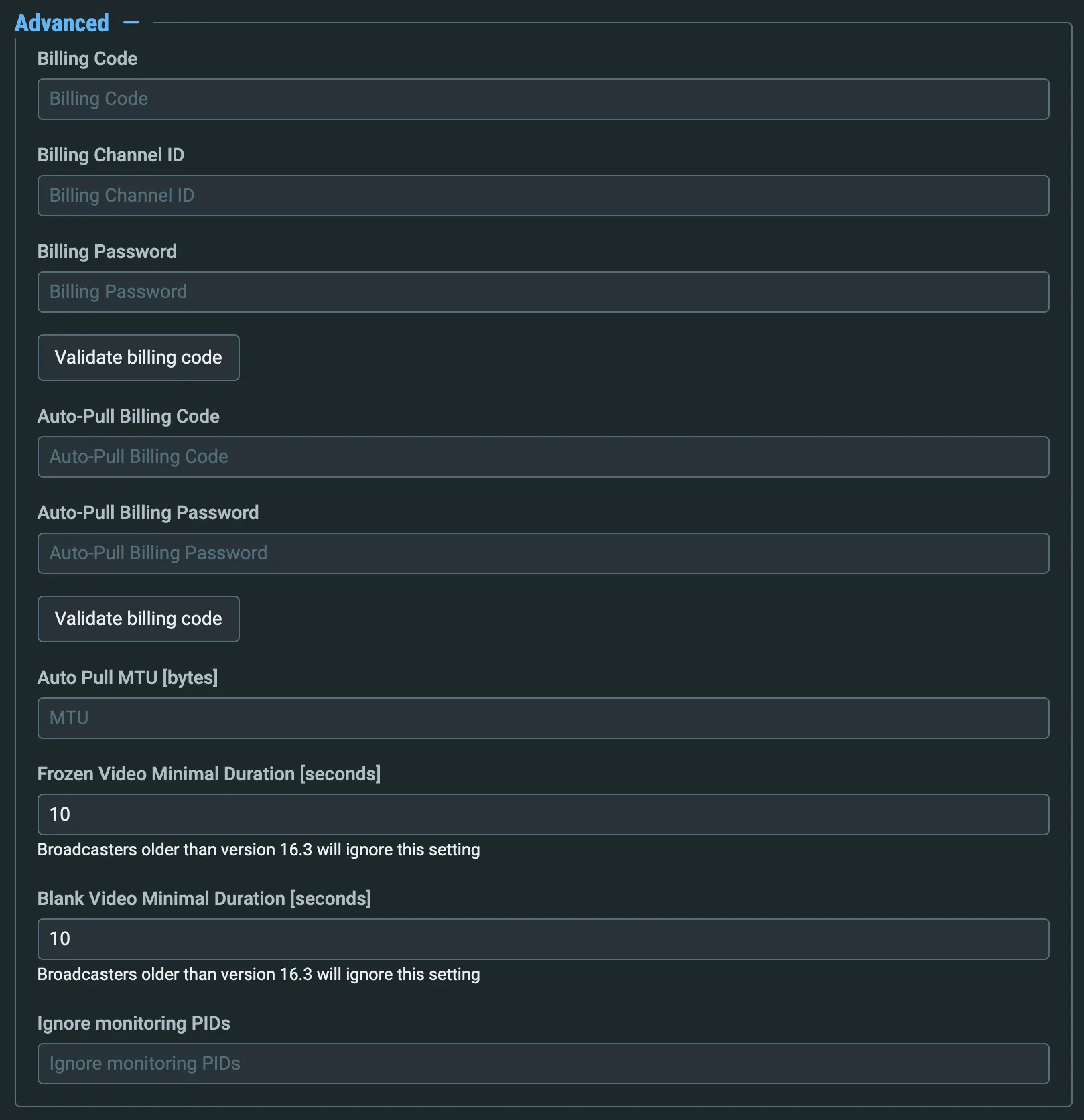
To track usage for this Source, enter your Billing Code details. See Billing Codes.
In the Auto Pull MTU field, specify the maximum transmission unit (largest data packet that a network-connected device will accept) in bytes for the Auto Pull.
To set the detection of frozen video, in the Frozen Video Minimal Duration field, specify the default minimal duration in seconds of frozen video after which the Broadcaster will trigger a Frozen video alert. Default: 10 seconds. This setting is supported for Broadcaster version 16.3 and higher.
To set the detection of blank video, in the Blank Video Minimal Duration field, specify the default minimal duration in seconds of blank video after which the Broadcaster will trigger a Blank video alert. Default: 10 seconds. This setting is supported for Broadcaster version 16.3 and higher.
Click Save.
Multiviewer Source Configuration Parameters Table
Parameter | Description |
|---|---|
Info | |
Name | Specify a name for the Multiviewer Source in ZEN Master |
Tags | Select one or more of the predefined Tags from the drop-down list. Tags are used for access control. By selecting an Tag, you are relating this Source to that Tag. Tags are associated with certain roles (through the Users & Roles screen), and roles, in turn, are associated with users and user groups. If you would like to create a new Tag, see Creating a Tag . |
Events Configuration Profile | Select from the dropdown list the profile that you would like to apply to this Source. By default, the Default profile is applied. Note: Events Profiles consist of a series of rules that determine precisely how various types of Events are logged and what results they trigger. |
Location (Optional) | The Source’s location is used to represent it in the proper position in the Map display (see Maps). By default, the location is determined automatically based on the Source’s IP. Enter identifying info for the location (e.g. street address, zip code, coordinates) and select the desired location from the suggestions that are shown. |
Inputs | |
Multiview Type | The following is supported:
|
Multiviewer | Select the relevant Multiviewer from the drop-down menu. This list is populated by the objects that were configured in the screen. |
Layout | For TAG option, select the desired layout from the list of preconfigured layouts. These layouts are configured in the TAG system itself. After selecting the desired layout, an empty grid is displayed with empty rectangles to assign the desired sources from the list of sources. |
Encoder | Select the relevant Encoder profile. Encoders are configured in the TAG system itself. |
Sources | In the Sources section, do one of the following:
|
Configuration | |
Ingest Cluster | Select from the drop-down list one of the available Ingest Clusters as the destination for the Source. |
Target Broadcaster/s | Select your Broadcaster preferences. Either select a specific Broadcaster to be used OR specify your preference for using primary vs. backup Broadcasters. Options are: Prefer Primary Broadcasters, Primary Broadcasters only, Backup Broadcasters only or Prefer Backup Broadcasters. Note: For managed clusters, it is not recommended to select a specific Broadcaster, as the Broadcaster’s availability may not remain stable. |
Profile | For the Zixi option, select a Transcoding Profile which will be used for encoding purposes. ZEN Master offers default profiles, but additional profiles can be configured. See Transcoding Profiles. |
Public Output | To allow access to the stream directly through a supported player, select the Allow checkbox. |
Content Analysis | Select one of the following options:
|
Hide Thumbnail | Disables the Source thumbnail from appearing in the Sources list and other places. Disabling thumbnail may improve system performance. |
Monitor CEA-608 Closed Captions | To monitor CEA-608 closed captions, select this checkbox. Note: Monitoring CEA-608 Closed Captions requires using a Broadcaster version 14.4 or newer. |
Monitor CEA-708 Closed Captions | To monitor CEA-708 closed captions, select this checkbox. Note: Monitoring CEA-708 Closed Captions requires using a Broadcaster version 14.4 or newer. |
Disable Auto-Pull | To disable auto-pull, select this checkbox. Note: Disabling Auto-Pull will lock Channels using this Source to the Source's Ingest Cluster and Targets to the Source's current active Broadcaster. This setting only applies to Pass-Through Channels. |
Auto-Pull Latency [ms] | Specify the desired latency for auto-pull actions. (Default: 1,000 ms). |
WebRTC Playback | Select the desired playback method. Note: WebRTC enables you to monitor the stream via web browsers and mobile applications with real-time communication (RTC). WebRTC needs to be activated independently for each Source in ZEN Master (by default it is disabled). Select one of the following options: Disabled - users will not be able to view this Source using WebRTC (default). Pass-Through - passes the stream through to WebRTC without transcoding. This option can only be used if the input stream is already in a WebRTC compliant format (video - H.264 codec with Baseline or Main profile and no B frames, Audio - Opus codec). Auto - ZEN Master automatically transcodes the stream using the optimal profile for each specific user. In this option Zixi Broadcaster will decode the video, transforming it into RAW frames, which will be passed to the WebRTC library, where it will be re-encoded for each individual user. Note: Best quality. However, if monitored by multiple users this can consume extensive resources. 1080p/720p/480p/360p - ZEN Master transcodes the stream to a WebRTC compliant profile with the specified resolution. The transcoding is done by Zixi Broadcaster's transcoder. Note: This method requires a Zixi Broadcaster with X264 or Nvidia for transcoding. This method allows many users to monitor the stream without encoding separately for each individual user, which saves CPU capacity. Since there is only one stream resolution, it is recommended to encode to a low resolution and low bitrate so that the stream will be viewable by all users monitoring the stream. |
SCTE-35 Manipulation | |
Enable SCTE-35 Manipulation | To enable SCTE-35 Manipulation, select this option. |
SCTE-35 PID | Set the SCTE-35 PID in which the messages will be inserted. |
Remove Existing SCTE-35 | Remove any existing SCTE-35 messages from the stream. |
NULL Packet Search Window (ms) | Replace any existing SCTE-35 messages with NULL. |
Initial State | |
Disabled | To disable this Source upon initial configuration, select this option. |
Muted | To disable error/recovery notifications for this Source upon initial configuration, select this option. |
Advanced | |
Billing Codes | To track usage for this Source, enter your Billing Code details, see Billing Codes. (Supported for Broadcasters v14.8+) |
Billing Channel ID | An optional arbitrary string - you can enter anything you want to for your record-keeping. This is not related to ZEN Master Channels. |
Billing Password | Optionally specify a password for the billing code. |
Auto-Pull Billing Code | To track usage for this Source when using Auto-Pull connections, enter the billing code that corresponds to this stream. The relevant billing can be obtained from the organization that received the billing code from Zixi. |
Auto-Pull Billing Password | Enter the password that corresponds to this auto-pull billing code. |
Auto-Pull MTU (bytes) | Specify the maximum transmission unit (largest data packet that a network-connected device will accept) in bytes for the Auto Pull. |
Frozen Video Minimal Duration (seconds) | Specify the default minimal duration in seconds of frozen video after which the Broadcaster will trigger a Frozen video alert. Default: 10 seconds. This setting is supported for Broadcaster version 16.3 and higher. For existing sources, you may need to restart the source. |
Blank Video Minimal Duration (seconds) | Specify the default minimal duration in seconds of blank video after which the Broadcaster will trigger a Blank video alert. Default: 10 seconds. This setting is supported for Broadcaster version 16.3 and higher. For existing sources, you may need to restart the source. |
Ignore Monitoring PIDs | Ignore PIDs for empty audio streams to prevent false warnings - enter a comma-delimited list of PID numbers that should not be monitored for null content. |