ZEC Adding File Streams
This input creates a file input for the ZEC from a local or mounted disk and subsequently streams it to the end-user.
If the stream is an MPTS stream, you can either upload it as an MPTS file or you can demux it into separate SPTS input streams. To Demux the MPTS stream, create the input stream by following the instructions below, and then follow the instructions in the Demuxing an MPTS StreamDemuxing an MPTS Stream section.
To Add a File Stream:
In the ZEC Navigation menu, click the Inputs tab.
In the Menu bar, click +New Input.
The Add a new input stream window is displayed.
Enter the unique Stream ID.
Note this must be identical (case sensitive) to the stream name configured in the sending Zixi Broadcaster or MediaConnect.
Select the maximum concurrent connections to this stream from the Max. Outputs drop-down list. Default: Unlimited.
Select the Show in Matrix check box to display this stream in the Matrix (see ZEC Using the Matrix). Default: Selected.
Select the Log this stream checkbox if you would like to generate event logs for this input.
Select the Analyze checkbox if you would like to enable stream analysis for the input.
Select File for the input stream.
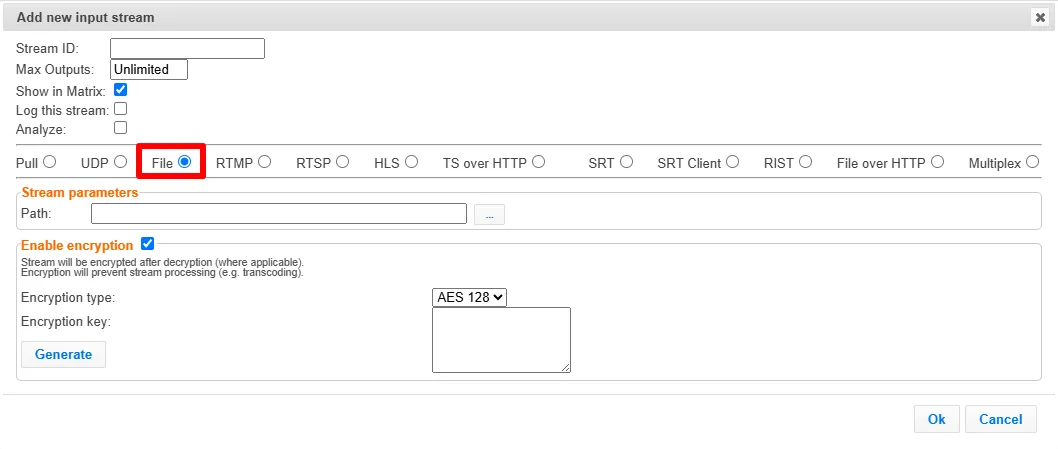
Specify the Stream Parameters (see the Input Stream Parameters TableInput Stream Parameter Table below).
If you want to Enable encryption, select this checkbox (see Input Stream Parameters TableInput Stream Parameter Table). For more information, see ZEC Encrypting an Input Stream.
Click OK.
The “Input added” message appears at the top of the screen. The stream is added to ZEC and now appears in the list of streams available in the ZEC inputs UI.
Input Stream Parameters Table
Parameter | Description |
|---|---|
Stream Parameters |
|
Path | See Notes on the File Path below. |
Enable Encryption | Select this checkbox to encrypt the Input stream. The stream encryption prevents any further processing, such as analysis, transcoding, etc. The encryption works in the following way:
For more information, see ZEC Encrypting an Input Stream. |
Encryption type (for Encryption enabled) | Specify the type of Encryption (AES 128/192/256). |
Encryption key (for encryption enabled) | Click Generate to generate an encryption key. The generated encryption key must be sent to the end-user to decipher the received encoded stream. |
Notes on the File Path
- The paths the ZEC understands here are not operating system paths - full system paths such as /home/user/videos/file.ts or C:\home\videos\file.ts will not work.
- Instead, the file you wish to use must be in the root folder for the ZEC. The location of the root folder is shown in the General settings of the Settings tab:
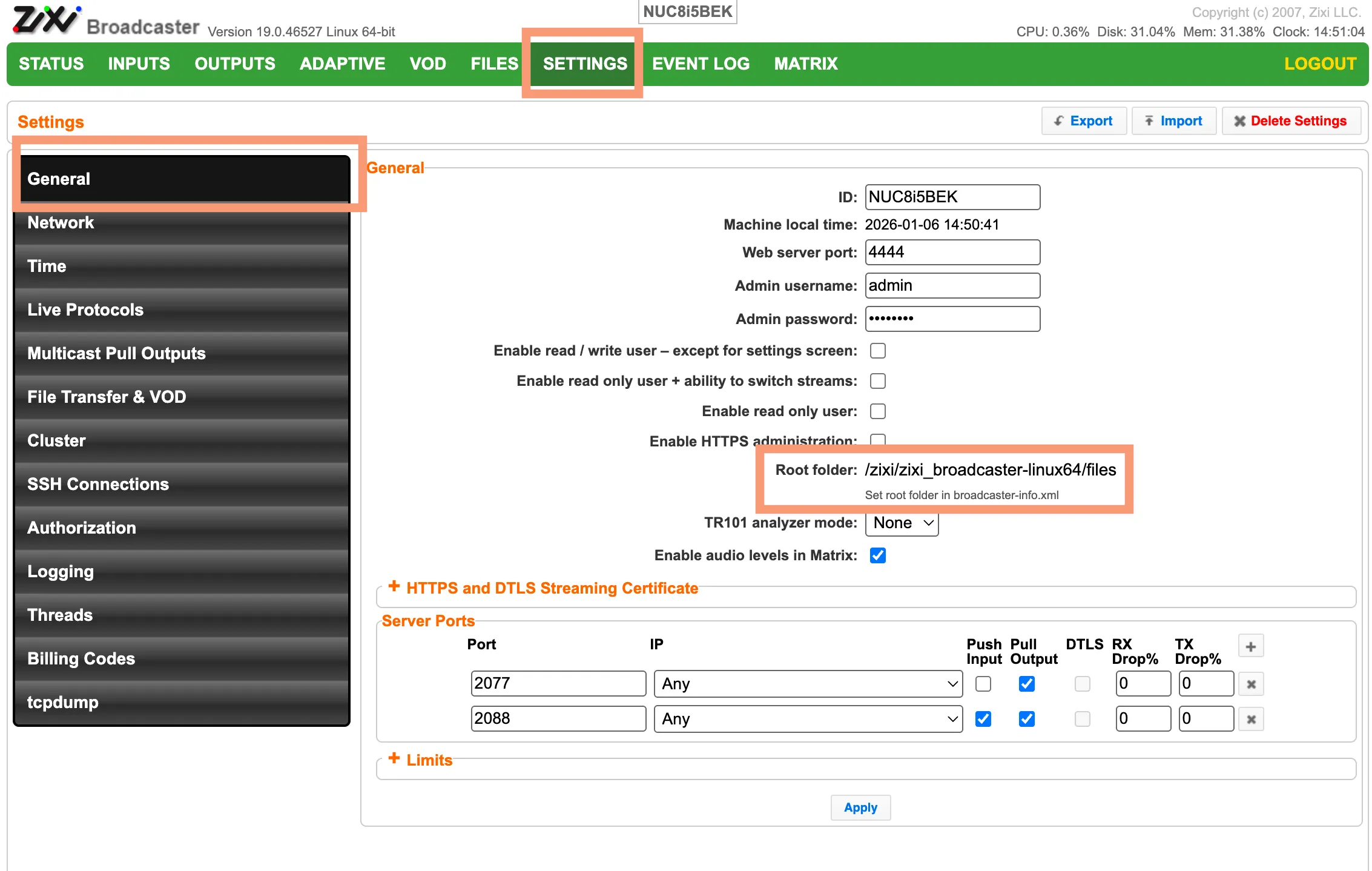
- Note that to change the root folder location, you must edit the broadcaster-info.xml file, which is located in the Broadcaster installation folder.
- On the Files tab, you can upload files to the Broadcaster for use as file streams and also create subfolders to organize files.
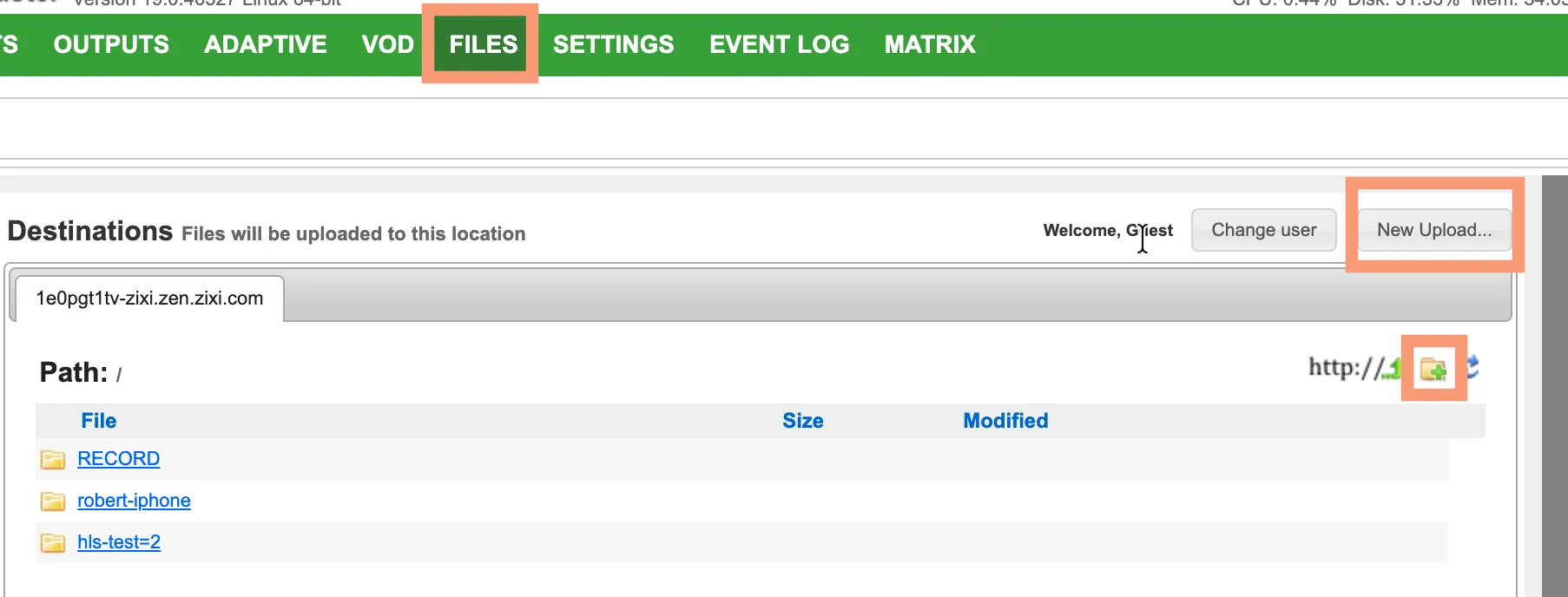
- For files in subfolders, the Path is relative to the root folder - for example, if you create a videos subfolder and within the videos folder create another subfolder called nature, and you want to use a file called forest.ts for the file stream, the path would be: /videos/nature/forest.ts
Advanced Mode
The fields discussed below are optional and available only in Advanced Mode.
To enter Advanced Mode add the URL parameter ?advanced=1 to the ZEC URL in your browser and press Enter/Return to reload the page:

Note the Advanced Mode settings are generally intended for advanced users and special cases. If you do not understand the settings, you should probably accept the default values.
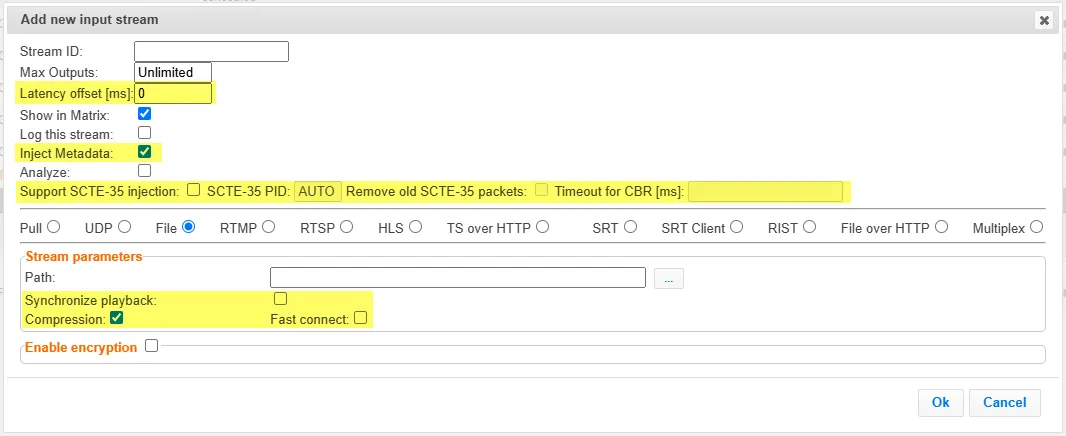
General
- Latency Offset [ms] - Specify the additional buffering time in milliseconds. Increasing this value can improve stream stability in unstable network conditions, but will increase end-to-end delay. Default: 0 ms
- Inject Metadata - allows Zixi create a PID that carries information about what hops a feed has travelled through on the way to its destination, it includes things like CC errors and IAT at each hop. The information is useful for debugging issues with streams.
- Support SCTE-35 injection - Select this checkbox if you would like the stream to support SCTE-35 insertion.
- SCTE-35 PID - Enter a PID number for SCTE-35 injection. You can enter a value manually or use the Up/Down arrows that appear when clicking the field. (or leave as Auto to match existing SCTE-35 PID)
- Remove old SCTE-35 packets - If SCTE-35 injection is supported, select this checkbox to clear out existing packets.
- Keep Stream CBR - Select this checkbox to insert on NULL packets and maintain PCR Accuracy in CBR Streams.
Stream Parameters
- Synchronize playback - ties a looping file's position to wall-clock time instead of to when the input was started.
When it's OFF (default): the file simply starts from the beginning when the input starts and loops from there. If you restart the input, or start the same file on a second Broadcaster, each one begins at the start of the file at the moment it was started - so they will not be at the same point in the file as each other.
When it's ON: the Broadcaster calculates where in the file it would be if the file had been playing continuously since a fixed reference time and jumps straight to that position. This means: The playout position is deterministic from the clock — restarting the input resumes at the "correct" point for the current time rather than jumping back to the beginning. Two or more Broadcasters playing the same looping file will stay aligned with each other because they all compute their position from the same clock reference rather than from their individual start moments.
This is what makes it possible to have multiple servers (or a restarted input) present the same looping file content in lock-step, as a continuous "always-on" channel, rather than each copy starting from frame one whenever it happens to be launched. PCR, PTS, and DTS are all derived from the NTP time.
- Compression - Enables bandwidth optimization by replacing NULL packets with signaling information embedded in packet headers. This reduces the overall bitrate without affecting content integrity. Since not all receivers support this compression method, it is optional. The system can receive compressed streams, but will only transmit compressed data when this option is explicitly enabled.
- Fast connect - Enables faster session establishment by reducing the time required to initiate the RIST connection. This is useful in environments where rapid recovery or quick stream startup is required. Support for this feature may vary depending on the receiving endpoint.