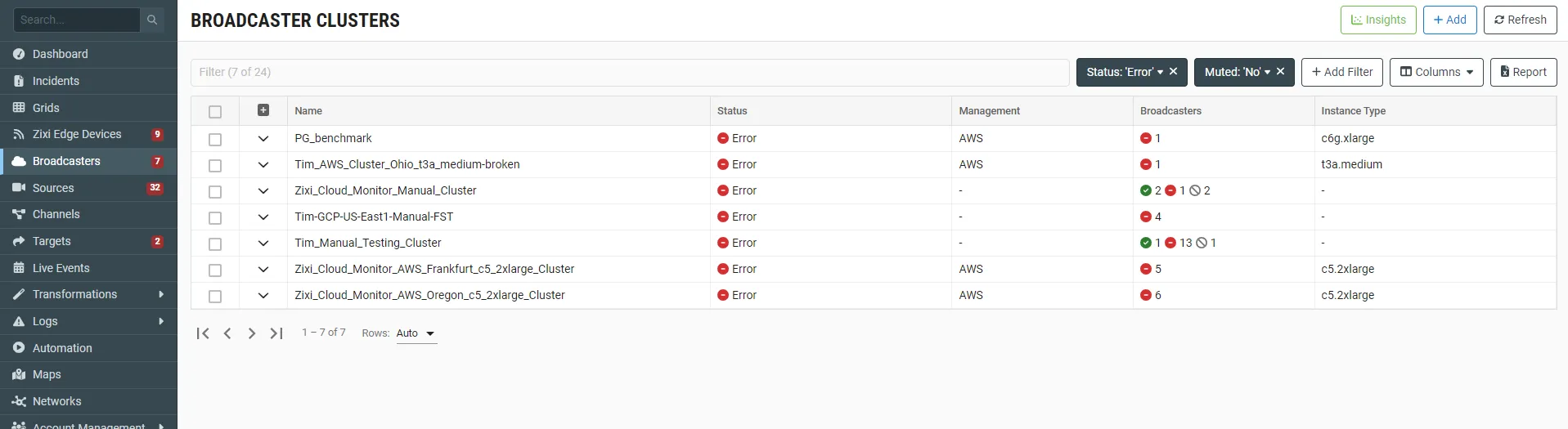
Main Screens
2 min
You can access each of the main screens by clicking on the screen in the Navigation pane on the left side of the screen.
The following is a brief description of the main screens:
- Dashboard – provides an overview of the status of your ZEN resources as well as a summary of recent activities and events in your ZEN system. See chapter Dashboard.
- Maps - The Maps screen shows your Resources (Feeders, Broadcasters and Receivers) and other system objects (Sources and Targets) on a geographical map. Communications between these objects are displayed as connecting lines showing the direction of data flow. See chapter Maps.
- Grids – Grids show a high density presentation of the resources and other objects that are configured in ZEN Master. Grids are highly configurable (objects displayed, info shown, screen layout etc.) enabling you to monitor the current status and performance of various objects in your system. See chapter Grids.
- Incidents – The Incident view groups together related errors in a causal flow which simplifies the process of identifying the common root cause. ZEN Master identifies the object on which the initial error occurred and the network on which the channel is transmitted. It also suggests a likely cause of the incident. See chapter Incidents.
- Zixi Edge Devices – displays all the ZEC, Feeders, and Receivers that are managed in ZEN Master. See chapter Zixi Edge Devices.
- Broadcasters – displays all of your Zixi Broadcaster clusters that are managed in ZEN Master. For each cluster, information is shown about the clusters' status and performance, see Viewing Existing Clusters. On this screen, you can add new Broadcaster clusters and manage existing clusters.
- Sources – displays all existing Sources, and information about the status and configuration of each Source. See Viewing Existing Sources. On this screen, you can add new Sources and manage existing Sources.
- Channels – displays all existing Channels, and information about the status and configuration of each Channel, see Viewing Existing Channels. On this screen, you can add new Channels and manage existing Channels.
- Targets – displays all existing Targets, and information about the status and configuration of each Target. See Viewing Existing Targets . On this screen, you can add new Targets and manage existing Targets.
- Transformations - displays profiles for different methods of transforming streams, i.e. Transcoding or PID Mapping.
- Transcoding Profiles – displays all existing Transcoding profiles and details about their configuration. See Viewing Existing Transcoding Profiles. On this screen, you can add new Transcoding Profiles and manage existing Transcoding Profiles.
- PID Mapping Profiles - displays all existing PID Mapping profiles and details about their configuration. See Viewing Existing PID Mapping Profiles. On this screen, you can add new PID Mapping Profiles and manage existing PID Mapping Profiles.
- Events – displays a log of all events/alarms such as connections, errors, disconnections etc. See chapter Events. On this screen, you can view sort and manage all logged Events.
- SCTE-35 - displays a log of all SCTE-35 markers. See chapter SCTE-35. On this screen, you can view sort and manage all logged SCTE-35 markers.
- Automation – displays a list of your automated tasks and task groups. On this screen you can add new automated tasks and manage existing automated tasks. See chapter Automation .
- Reports – displays all created Report configurations. On this screen you can create new Reports, generate Reports from existing configurations and download Reports. See chapter Reports.
- Single Sign-On – displays your SSO account details. See chapter Configuring Single Sign-On Account Settings. On this screen you can configure your existing SSO accounts and create new SSO accounts.
- API Keys – access existing API keys and create new ones. You can also access a link to the ZEN Master API documentation, see Configuring API Keys.
- SSH Security & Keys – view a list of the SSH keys available in your system as well as the tag/s associated with each key, see Configuring SSH Keys.
- Amazon AWS – view your linked AWS accounts and link new accounts, see Configuring AWS Account Credentials.
- Microsoft Azure – view your linked Azure accounts and link new accounts, see Configuring Microsoft Azure Account Credentials.
- Google GCP – view your linked GCP accounts and link new accounts, see Configuring Google GCP Account Credentials.
- Remote Access – view your Remote Access configurations for non-Zixi devices that you access through Zen Master. On this screen you can add new Remote Access configurations and manage existing ones. See chapter Remote Access.
- Licenses – view your ZEN Master licenses.
Main menu error indicators
The main menu elements may include red number indicators, which indicate the number of objects within this category that have an error.
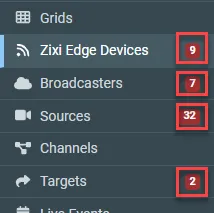
Clicking the red number will open the screen, while filtering to display only the object with the errors.